What Are the Benefits of Having an On-Site CWI?
For OEMs, every fabricated component carries weight. Parts must meet drawing specifications, arrive on schedule and perform reliably in the field. A single misstep during production can cascade into delayed assembly lines, expensive rework or field failures that erode client trust and reputation.
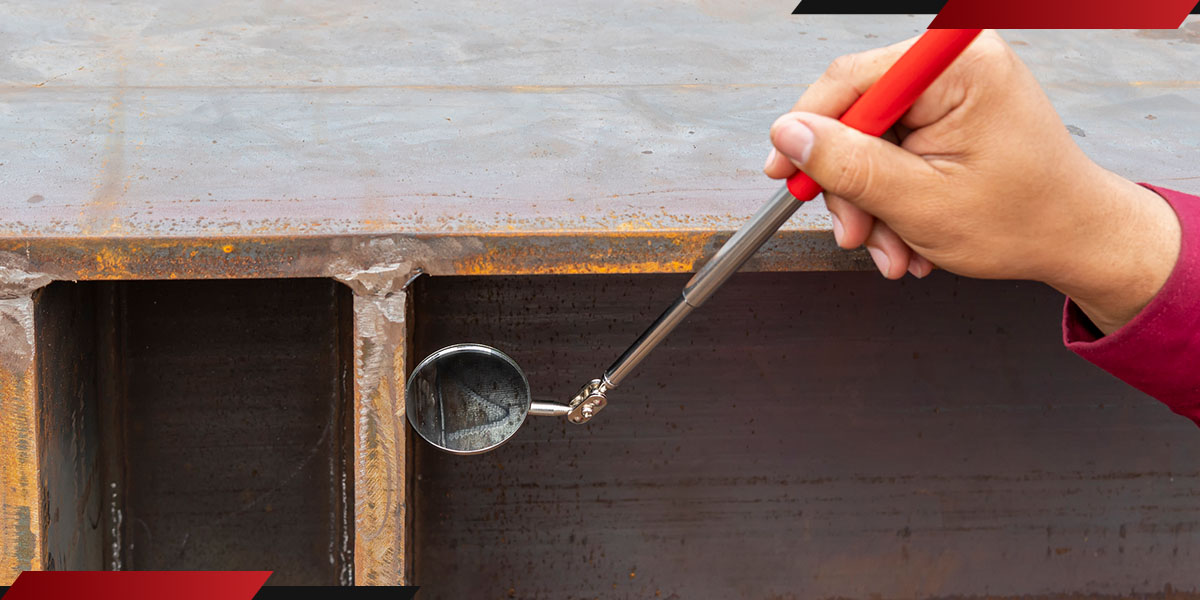
Welding is at the center of that risk, and quality depends entirely on who’s overseeing the work and when. Certified Welding Inspectors (CWIs) bring credentialed expertise to the floor, catching problems during fit-up, ensuring code compliance and maintaining the documentation OEMs need.
What Is the Role of a CWI?
A CWI is a professional credentialed by the American Welding Society (AWS) after passing a rigorous three-part examination covering welding fundamentals, practical inspection and code application. To qualify, candidates must pass a vision test and demonstrate a combination of education and welding-based work experience.
Their scope covers visual inspection, welding procedure specification review, welder qualification records, non-destructive testing methods, drawing and symbol interpretation, and documentation. The CWI ensures welding work meets the applicable standards and that every step is documented to support quality and traceability.
Why CWIs Are Indispensable for OEMs
For many OEM-driven or code-governed projects involving structural, pressure vessel, pipeline, rail, military, marine, or oil and gas applications, welding inspection by a CWI isn’t optional. Standards like AWS D1.1, ASME Section IX, or API 1104 mandate it, and contractor manufacturers without a CWI simply can’t pursue that work.
Pro-Cise’s qualified team understands and upholds these stringent standards, ensuring precise execution of your drawings and prints. With our professional on-site CWI, we leverage documented welding procedures that cover joint operations for unique materials and maintain strict material traceability. This infrastructure supports the code-specific welding standards that many OEMs require.
Customers don’t have to hope their parts meet standards after the fact — oversight is built into the process from material sourcing through final inspection. Our welding capabilities reflect that commitment to manufacturing quality control.
The Advantages of an On-Site CWI
Outside or third-party inspectors arrive after the work is done, which limits what they can prevent. An on-site CWI works within the production environment, able to catch problems at fit-up, during welding, and before assemblies are completed. The biggest value is having someone involved before and during fabrication, when problems can still be corrected quickly.
At Pro-Cise, quality is built into every stage of the process, including the presence of an on-site CWI. We manage the full production process from material sourcing to shipping, and our fabrication capabilities demonstrate that end-to-end quality commitment.
1. Faster Inspections and Approvals
Welds can be reviewed during production instead of waiting for third-party inspection. With an on-site CWI at Pro-Cise, reviews happen in real time, keeping projects on schedule and maintaining production momentum for OEMs who depend on timely delivery.
2. Earlier Problem Detection
Fit-up, joint preparation, weld size, procedure use and welder technique can be checked before an issue becomes expensive rework. Catching defects like porosity, undercut or lack of fusion at fit-up takes minutes to resolve. Discovering those same issues after painting or final assembly can cost days and significant materials. This before-and-during oversight directly protects the OEM’s investment and timeline.
3. Reduced Rework and Scrap
Catching problems before assemblies are completed, painted or shipped can lower repair costs and production delays. Pro-Cise’s on-time delivery and quality production reduce rework and scrap, preventing impacts to delivery, operations and your customers.
4. Better Control of Welding Documentation
A CWI can help manage welding procedure specifications, welder qualification records, procedure qualification records, inspection reports, and required certifications. For OEMs in regulated industries, this documentation isn’t optional.
Pro-Cise already maintains strict traceability and has the infrastructure to support the full compliance chain. Our weld quality standards reflect the rigor that customers in oil and gas or defense require.
5. Improved Consistency
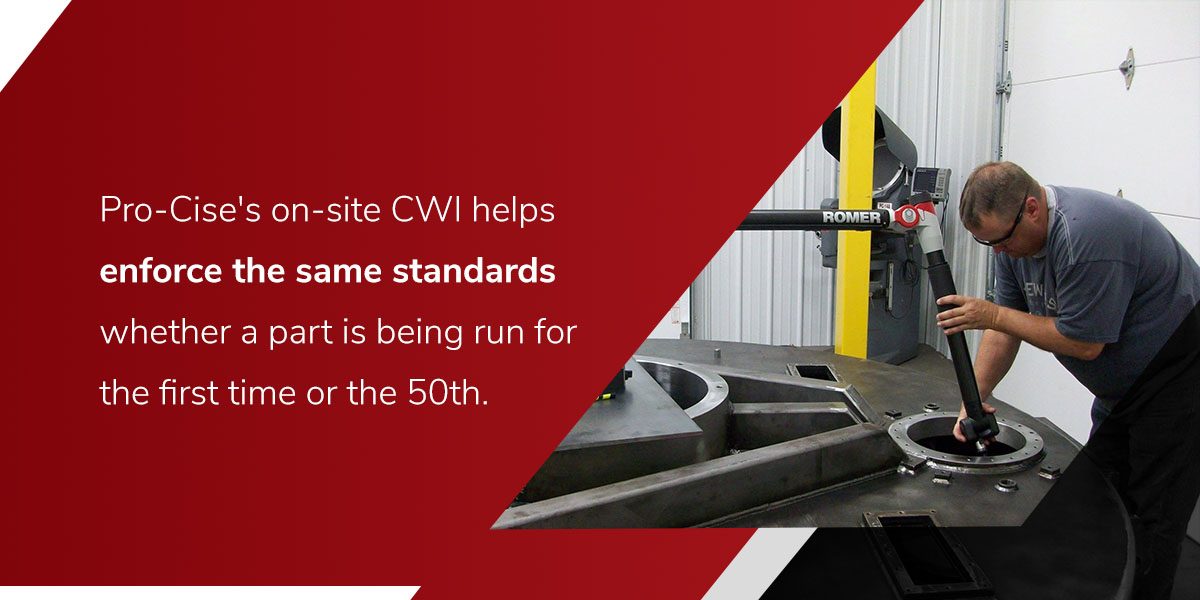
The CWI can help standardize expectations across welders, shifts and different projects. OEMs running production schedules, especially those with repeat or high-wear parts, need consistency across every run. Pro-Cise’s on-site CWI helps enforce the same standards whether a part is being run for the first time or the 50th.
6. Support for Higher-Specification Work
Some structural, rail, military, pressure-related or code-driven projects mandate documented welding inspection. An in-house CWI unlocks the capability to pursue that work. By having an on-site CWI, Pro-Cise can take on complex, code-driven welding requirements that many shops can’t. We’re a viable partner for OEMs in defense, oil and gas, marine, and rail sectors where this credential is a prerequisite.
7. Stronger Customer Confidence
Being able to say that welding is overseen by an AWS Certified Welding Inspector strengthens a company’s quality message. For an OEM evaluating fabrication shops, the presence of a CWI is a tangible trust signal. Pro-Cise’s commitment to quality reinforces OEM confidence in us as a long-term manufacturing partner.
8. Training and Coaching
A good CWI can help welders understand persistent challenges, drawing requirements, weld symbols, acceptance criteria, and proper procedures. The CWI role involves more than just inspection. It’s also about improving the welding team over time. This means fewer repeat problems, better adherence to complex drawings and prints, and a workforce that consistently raises the bar.
9. Better Communication Between Departments
The CWI can help translate specifications between engineering, quality, production, customers and outside inspectors. In a precision manufacturing environment, miscommunication across departments can result in nonconforming parts. The CWI acts as a common language, interpreting code standards, GD&T callouts on drawings, and customer specifications across every team that touches the part.
10. Fewer Shipping or Field Issues
Problems are more likely to be caught before the product leaves the facility. Field failures can trigger warranty claims, costly field service interventions or, in severe cases, recalls that impact the OEM’s end customers. Pro-Cise’s on-site CWI represents a final quality gate. Parts that leave the facility have been reviewed against the applicable standards and customer requirements, not just assembled and boxed.
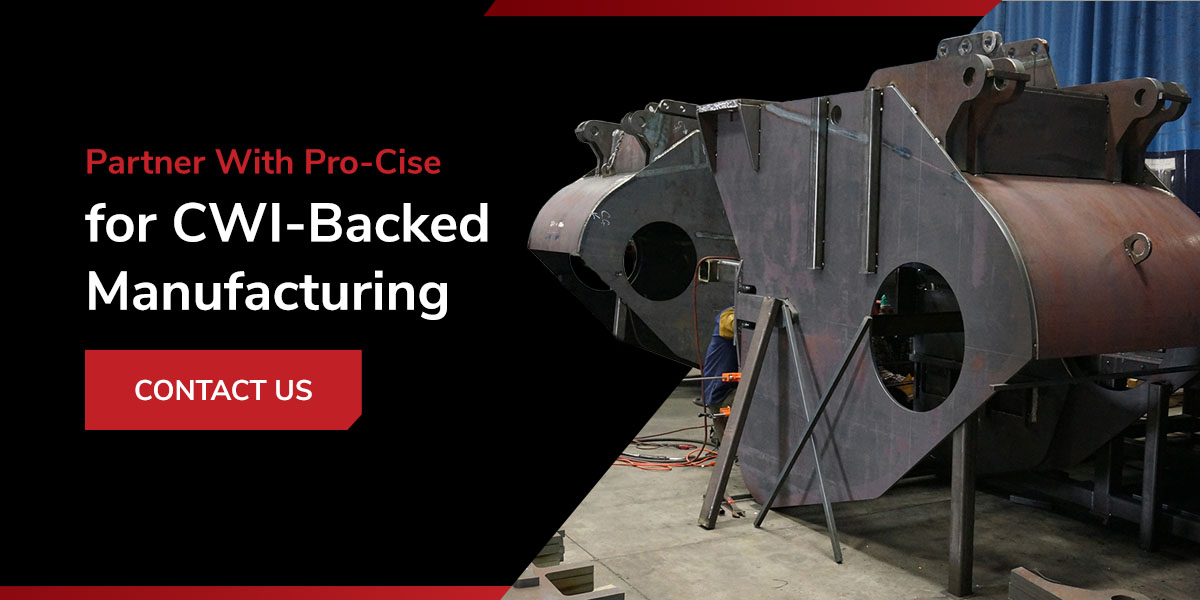
Partner With Pro-Cise for CWI-Backed Manufacturing
Having a CWI embedded in production means problems get solved on the floor, not in the field. For OEMs in code-governed industries like defense, oil and gas, marine, rail, or pressure applications, this capability is often a prerequisite. Pro-Cise is that shop.
We take on complex projects that other shops won’t and back that capability with qualified oversight. Our team manages production from material sourcing to shipping, working from your drawings and prints to deliver engineered parts on spec and on time.
Connect with Pro-Cise to discuss your requirements and learn how our on-site CWI supports every stage of your production process.