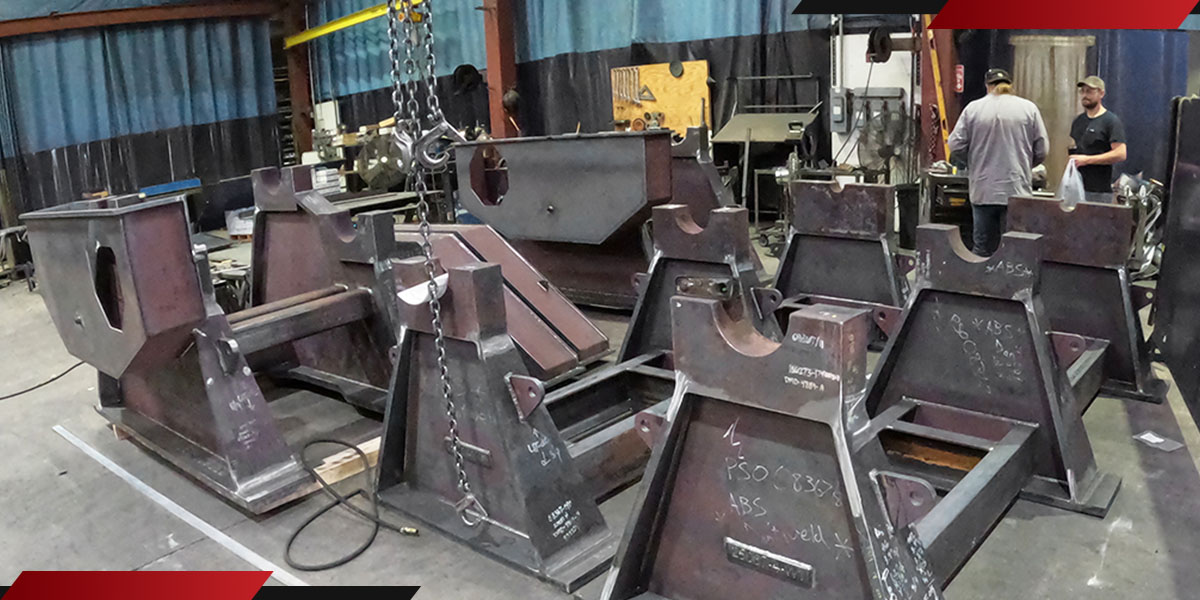
Weld quality is determined by a combination of visual inspections, nondestructive testing, and destructive methods to distinguish high-quality welds from common defects like porosity, cracks, and incomplete penetration.
A good weld vs. bad weld plays a decisive role in the safety, performance and longevity of welded components. In highly regulated sectors such as manufacturing, construction, aerospace and heavy equipment production, even minor defects can lead to costly failures or structural hazards. Understanding how to test weld quality is essential for maintaining consistent production standards and protecting the integrity of your projects.
A welding quality check begins with visual inspection. Comprehensive assessment involves a mix of nondestructive testing (NDT) and, in some cases, destructive methods to determine mechanical strength and durability. Recognizing good welding and identifying flaws seen in bad welding helps prevent defective components from entering service.
Key Welding Defects and How to Identify Them
Common defects vary in cause and severity. By understanding their appearance, origins and potential consequences, inspectors and fabricators can quickly distinguish between good and bad welding examples and take corrective measures before parts enter service.
Porosity
Porosity occurs when trapped gas forms cavities in the solidifying weld metal. It can appear as scattered pinholes or clustered voids visible on the surface. Excessive porosity can reduce fatigue strength and lead to premature failure. Common causes include moisture on materials, inadequate shielding gas coverage or dirty base metals.
Cracks
Cracks are among the most severe welding defects and can occur in various forms:
- Longitudinal cracks follow the weld axis
- Transverse cracks run perpendicular to the weld
- Crater cracks form at the end of a weld bead when cooling is too rapid
These discontinuities often stem from high residual stress, improper cooling rates, poor joint design or incompatible filler metals. Because cracks can propagate under load, they are considered unacceptable in all codes and standards.
Undercut
Undercut occurs when the base metal adjacent to the weld is melted away, leaving a groove that reduces cross-sectional thickness. This groove creates a stress concentration point that can initiate failure. Undercutting is often caused by excessive current, poor torch angle control or high travel speed. Detecting it early is essential for preserving joint strength.
Overlap
When molten weld metal flows over the base material without fusing to it, it forms an overlap. This condition leaves an unbonded edge that can serve as a crack initiation site under load. Overlap is typically the result of low travel speed, poor electrode manipulation or excessive filler metal deposition. It affects the weld’s mechanical performance and signals procedural errors that need correction to maintain welding quality.
Incomplete Penetration
Incomplete penetration arises when the weld metal fails to fully extend through the joint thickness, leaving an unfused area at the root that severely reduces joint strength. This defect often results from insufficient root opening, an improper joint design, low welding current or incorrect electrode size. It is particularly critical in load-bearing components because it creates a hidden weak spot. Proper joint preparation, correct travel speed and adherence to specified welding parameters are key preventive measures.
Visual Inspection: The First Line of Defense
Visual inspection is the most accessible and frequently used method for welding quality inspection. As a nondestructive testing technique, it can be performed before, during and after welding without damaging the component.
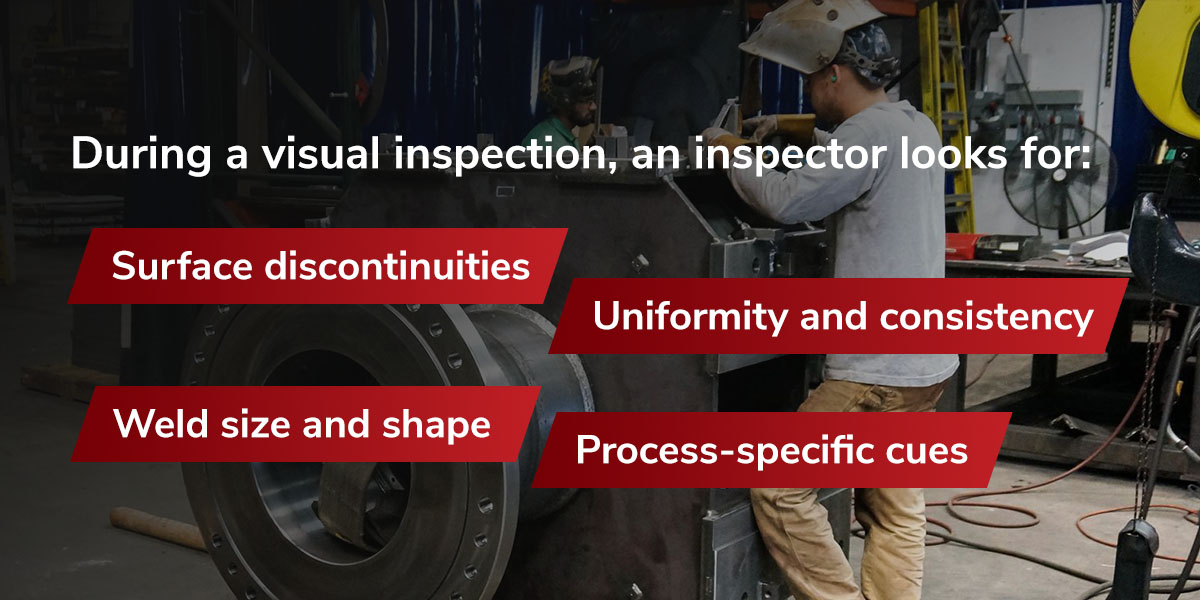
During a visual inspection, an inspector looks for:
- Surface discontinuities: Discontinuities may include cracks, porosity, undercut, overlap, underfill, excessive reinforcement and incomplete fusion.
- Weld size and shape: These include leg size, throat and bead contour. The inspector will check the termination quality against the drawing and code.
- Uniformity and consistency: The inspector will look for steady travel marks, an even ripple pattern and stable bead placement as hallmarks of good welding examples. Clusters of pinholes, sharp gouges at the toe and wash-over edges are bad welding examples.
- Process-specific cues: To distinguish between good and bad TIG welds, the inspector checks for heat tint, bead wet-out, arc starts/stops and contamination halos.
Fabricators use a range of tools to support visual checks, including:
- Fillet weld gauges to confirm leg length and throat thickness
- Magnifying glasses, flashlights and inspection mirrors help uncover subtle flaws in hard-to-reach areas
- Straight edge, tape and calipers for dimensional checks
- Temperature-measuring devices like pyrometers or Tempilstiks help verify interpass and preheat values
- Magnet to establish the nature of the material
- Protective lenses
Other Weld Testing Methods
While visual inspection is valuable, some defects remain hidden beneath the surface. To accurately assess the quality of welding, inspectors employ a range of additional testing methods:
- Liquid penetrant testing: This technique uses a visible or fluorescent dye to detect fine surface cracks and discontinuities on metals. After applying and removing excess dye, a developer draws out the penetrant from any cracks or pinholes, making them visible under appropriate lighting.
- Magnetic particle testing: MT uses fine magnetic particles and a magnetic field to identify surface and near-surface discontinuities in ferromagnetic materials. Particles gather at flaw locations, forming visible indications.
- Ultrasonic testing: In this method, inspectors use high-frequency sound waves to locate internal flaws such as lack of fusion, incomplete penetration or porosity. The results appear on a display, showing the size and location of discontinuities.
- Radiographic testing: RT uses X-rays or gamma rays to create an image of the weld’s internal structure, revealing defects such as slag inclusions, porosity or cracks.
- Destructive testing: Destructive testing methods, including bend and tensile tests, physically stress the welded joint to the point of failure. These methods measure mechanical properties like ductility, strength and toughness, providing definitive performance data.
Selecting the right approach depends on factors like material type, weld geometry, accessibility and required performance conditions.
Welding Quality Standards and Certifications
Global standards define what constitutes good vs bad welds and provide a consistent framework for assessment. For instance, ISO 3834 provides comprehensive quality requirements for fusion welding of metallic materials, covering everything from procedure specifications to personnel qualifications. Standards like ISO 14731 further define welding coordination roles, ensuring qualified individuals oversee planning, execution and inspection.
Meeting recognized standards is central to welding quality assurance. It confirms that processes, personnel and inspection procedures align with best practices and regulatory expectations. In addition to ISO-based frameworks, certifications from organizations such as the American Welding Society or the American Society of Mechanical Engineers signal technical competency and adherence to established criteria.
Contact Pro-Cise for Expert Production Welding Solutions
Weld integrity is one of the most critical factors in manufacturing, infrastructure, heavy equipment and many other critical applications. A structurally sound weld protects lives and equipment, while poor welding can compromise a product’s performance. Knowing how to test welding quality is a cornerstone of safe, repeatable fabrication.
For OEMs requiring complex, medium- to large-scale welded components, Pro-Cise delivers production welding services that meet demanding specifications. With qualified personnel, documented welding procedures, rigorous welding quality verification and advanced NDT capabilities, our team helps maintain the highest welding standards across every project.
Whether your needs involve large weldments, complex, multi-process welding, specialty materials or strict compliance requirements, we have the experience, facility capacity and process control to deliver precise, repeatable results. Contact us today to discuss your welding project and learn how Pro-Cise can support your manufacturing goals.