To verify the integrity of metal components without causing damage, manufacturers utilize magnetic particle, ultrasonic, dye penetrant, and radiographic testing to identify hidden surface and subsurface defects.
Modern metal fabrication has come a long way, but the greatest threats to product integrity are often lurking beneath the surface. The “hidden” dangers in fabricated metal components go far beyond what meets the eye. While a weld bead may look perfect and pristine, subsurface flaws such as internal porosity, micro-cracks and inclusions can silently compromise the entire structure.
Relying solely on visual inspection exposes OEMs and manufacturers to catastrophic product failures, costly recalls and severe safety hazards, especially in mission-critical industries like railway, mining, marine and defense. That is exactly why nondestructive testing (NDT) techniques for metal components have become a cornerstone of quality assurance for leading OEMs.
NDT methods allow manufacturers to verify the integrity of metal parts without damaging them. Unlike destructive testing, which involves breaking or deforming a sample, nondestructive metal testing gives you a complete picture of your product’s quality in its final or nearly final form. For OEMs tasked with delivering robust, safe and compliant products to demanding industries, NDT techniques for metal components are an essential risk mitigation strategy.
The Hidden Cost of Unverified Metal Components
It is easy to underestimate the risk posed by unseen flaws. Visual inspection is limited to surface anomalies and cannot spot many sources of failure, but undetected subsurface defects can trigger product recalls, unplanned downtime and even catastrophic safety events for end users. In high-stakes sectors, a single missed crack or inclusion can undermine months of engineering and put both people and reputations at risk.
Why Visual Inspection Is Not Enough for Critical Applications
Even the most skilled inspector cannot see through a weld or deep into a plate. Surface inspections can only assess what is visible, like paint, oxidation or surface cracks, while subsurface discontinuities remain invisible. Visual examinations miss “subsurface discontinuities,” which are the types of defects most likely to lead to structural failure or product liability. These situations are where nondestructive metal testing makes a considerable difference.
The Risks of Subsurface Defects in Large-Scale Fabrication
For those manufacturing medium to large-scale metal products, such as locomotive frames, military vehicles or food processing equipment, the risks go well beyond cosmetic imperfections. Among the most dangerous hidden flaws are:
- Slag inclusions: Nonmetallic solids trapped inside a weld
- Lack of fusion: Incomplete joining between base metals or weld layers
- Fatigue cracks: Micro-cracks developing under stress over time
- Porosity: Trapped gas bubbles inside welds
These flaws can develop during fabrication or under field conditions, but they are undetectable to the naked eye. Slag inclusions and porosity rank among the most common and costly hidden weld defects. If teams do not find and address these defects, they can precipitate structural failure during heavy use.
Essential Nondestructive Testing Methods for Heavy Industry Applications
At Pro-Cise, we deploy a full suite of nondestructive testing methods to ensure every metal component meets exacting standards before shipment. Learn how each method works and exactly what kind of flaws they are engineered to detect:

Magnetic Particle Testing (MT): Detecting Surface Cracks in Ferromagnetic Parts
Magnetic particle testing, also known as MT or MP, is a powerful tool for examining ferromagnetic metals such as steel and iron. The process involves magnetizing the component and applying specially formulated iron particles to the surface.
When a crack or discontinuity is present, it disturbs the magnetic field, creating a “leakage field” that attracts the particles and makes the flaw visible. As the aerospace standard ASTM E1444 describes, MT reliably reveals surface and slightly subsurface discontinuities, making it ideal for catching fine cracks, laps and seams near the surface on welds and critical load-bearing parts.
Ultrasonic Testing (UT): Finding Deep Subsurface Flaws
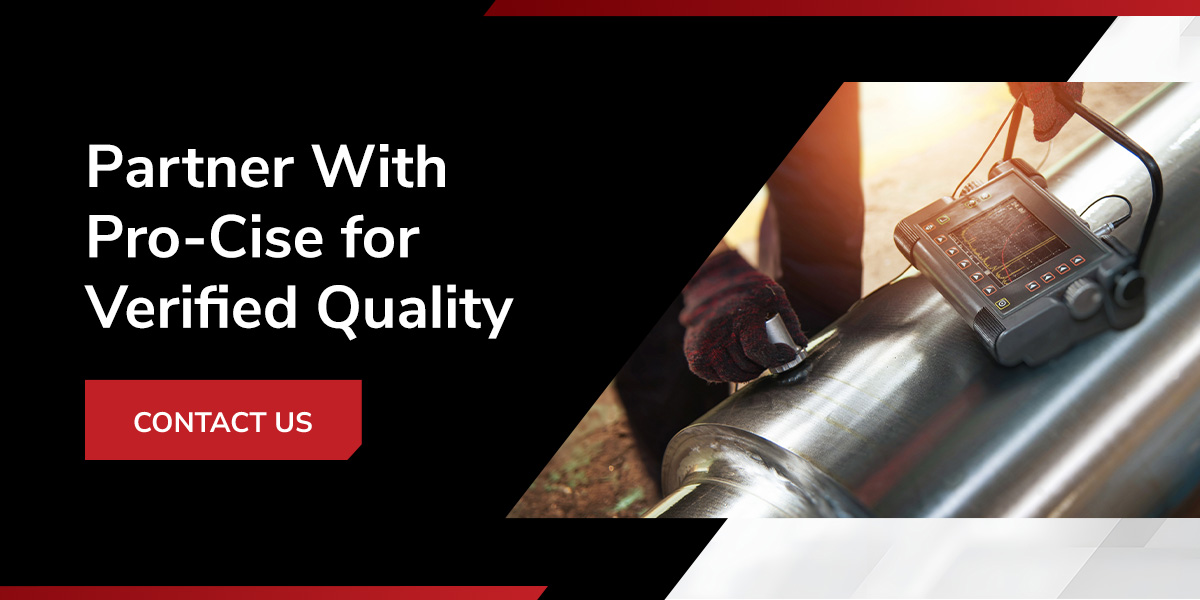
UT uses high-frequency sound waves to interrogate the material’s internal structure. By transmitting pulses and measuring the echoes, inspectors can map even the tiniest voids, cracks or inclusions hidden deep below the surface. UT is the go-to option for deeper welding defects, thick plates and areas inaccessible to surface methods. UT provides a volumetric view, helping OEMs ensure the entire cross-section meets their structural requirements.
Dye Penetrant Testing (PT): Verifying Nonporous Surfaces
PT is a low-cost, high-sensitivity method for detecting surface-breaking defects on nonporous material, including metals, some plastics and ceramics. The process starts by cleaning the part, applying a visible or fluorescent dye, and allowing a specified dwell time for the penetrant to seep into open cracks and pores. After removing the excess dye and applying a developer, even the smallest flaws become apparent. PT is highly effective at uncovering cracks, porosity, laps and seams.
Radiographic Testing (RT): Imaging Internal Structures
RT uses X-rays or gamma rays to create a permanent image of a component’s internal structure. This method excels at identifying internal cracks, corrosion and voids, which are flaws invisible to other techniques. While RT involves additional safety protocols, the ability to visually analyze hidden flaws without sectioning the part makes it invaluable for quality control in pressure vessels, welds and castings.
Matching the Method to the Material
Selecting the right nondestructive testing method depends on material properties and the type of defect you’re looking for. MT is the gold standard for identifying ferromagnetic surface cracks, while UT offers deep penetration and reliable imaging. PT delivers fast, low-cost results, and RT adds another layer by providing a visual record of the inside of virtually any material, especially when teams need permanent documentation.
When to Use Magnetic Particle vs. Ultrasonic Testing
For those in heavy industry, MT and UT are often top of mind. MT is fast and cost-effective, best for surface and near-surface defect detection on steels and irons. It is ideal for the final inspection of welds and joints. UT, by contrast, boasts deep penetration, providing a three-dimensional assessment of plates, thick welds and complex geometries. Ultimately, choose MT for surface and near-surface defects, and UT for thorough volumetric assurance.
Testing Standards: Understanding ASTM and ISO Requirements
The American Society for Testing and Materials (ASTM) and the International Organization for Standardization (ISO) create the industry benchmarks for quality. ASTM E1444 establishes best practices for MT, while ISO 9712 certifies NDT operators to ensure they are qualified for each method. Compliance with these standards gives clients confidence that every inspection meets or exceeds industry requirements.
The Strategic Value of In-House NDT Capabilities
Many metal fabricators still outsource their nondestructive metal testing, which adds days or even weeks to lead times. Pro-Cise eliminates these delays by performing all NDT techniques for metal components in-house. Our turnkey approach means we offer close integration between welding, inspection and final assembly.
Our nondestructive testing for metal components provides these benefits:
- Reduces lead times by eliminating third-party delays: We conduct inspections immediately so you can keep production moving without waiting for off-site parts shipment.
- Ensures accountability with qualified personnel: Our qualified experts perform all NDT to ISO 9712, AWS, ASME and ASNT standards, delivering reliable results.
- Delivers comprehensive quality documentation: We meticulously record each inspection, providing OEMs with full traceability and certified reports that meet rigorous customer and regulatory requirements.
Partner With Pro-Cise for Metal Testing Methods and Verified Quality Assurance
OEMs and manufacturers turn to Pro-Cise for top-tier fabrication. They trust us for rigorous, in-house quality verification. Our ISO 9001 certified processes cover the full suite of nondestructive testing methods, delivering both the documentation and the peace of mind expected by today’s most demanding industries. We serve clients across industries, including those in agriculture, construction, aerospace, marine, defense, mining and more.
Working with us means choosing a partner that’s committed to meeting and exceeding global standards. At Pro-Cise, we guarantee products and documentation that meet rigorous standards with every order, every time. Contact us or read Our Promise for Quality to start building with confidence.