
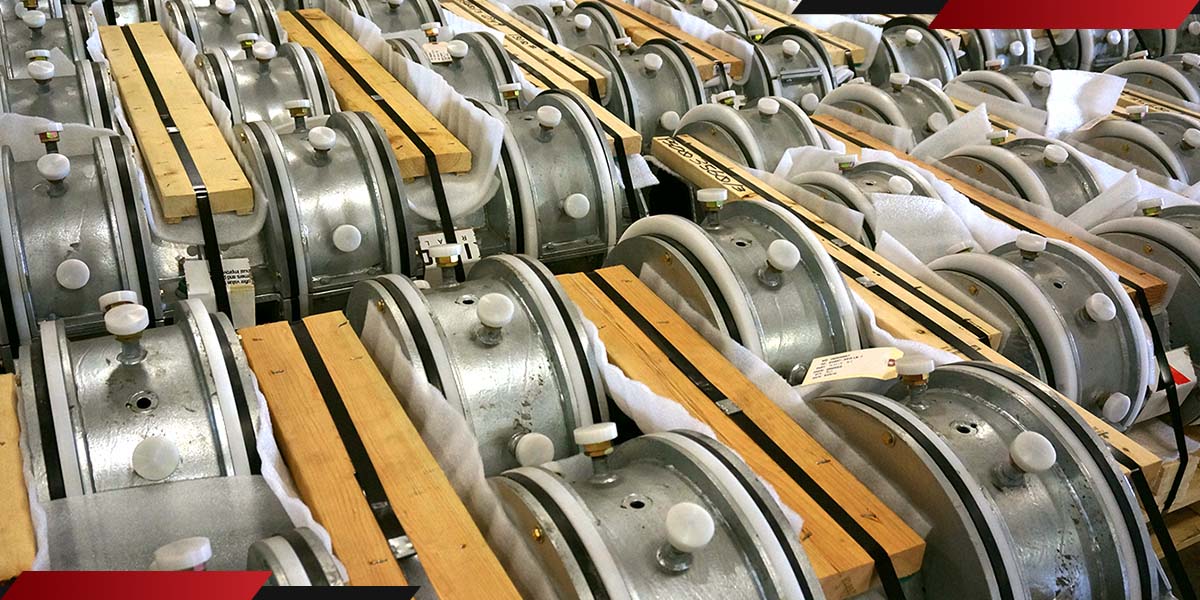
Selecting the right material for wear applications requires a strategic balance between hardness and toughness, while not ignoring the reliable manufacturability of the high-performance component.
When it comes to OEM equipment, the cost of a single component’s failure can ripple throughout your entire operation, causing unplanned downtime, driving up warranty claims and putting your reputation on the line. In heavy industries, the price of wear is never as simple as a replaced part. The true expense lies in lost production, field repairs and customer dissatisfaction. That’s why sourcing the right material for wear applications is a business imperative.
The Complex Nature of Wear in Heavy Industries
Wear is often an interplay between abrasion, impact and corrosion, with each mechanism attacking your component from a different angle. There’s always a trade-off, and any engineer with field hours knows that finding the perfect balance between hardness and toughness is no easy feat. Push one too far, and you end up with brittle parts that shatter under real-world stress.
However, there’s also a third factor that most design teams overlook: manufacturability. The ideal wear-resistance alloy may look unbeatable on a datasheet, but it might not work once it hits the fabrication floor. If the fabrication team can’t cut, machine or weld a material reliably, it’s not a solution.
Understanding the Primary Wear Mechanisms in Industrial Environments
Choosing the right material starts with knowing exactly what’s attacking your part. The threats in environments like mining, recycling, earthmoving and industrial food processing bombard components daily with a mix of abrasive, impact and corrosive forces. If you want long-lasting results, you must begin by defining the real opponents your parts will face.
Abrasive Wear (Two-Body and Three-Body Abrasion)
One of the most common sources of wear in earthmoving and agriculture is abrasive wear. Abrasive wear can come in two forms:
- Two-body abrasion: Here, a hard surface moves against a softer one, cutting or ploughing away material on a microscopic level. For example, a steel blade shaving against a softer conveyor belt would be a two-body abrasion process.
- Three-body abrasion: This abrasion occurs when hard particles, such as sand or gravel, become trapped between two moving surfaces. For example, bearings contaminated with dirt can cause grinding and accelerated loss.
Impact Wear and Surface Fatigue
Some wear is violent and fast. When bulk material crashes into a chute or a rock lands in a crusher, the resulting impact places immense shock on the receiving surface. Materials with maximum hardness may resist initial preparation but lack toughness, causing them to suffer brittle failure.
Surface fatigue occurs when components face repeated loading cycles. Over time, microcracks develop and eventually spall off, accelerating wear. Understanding how to choose the right high-wear materials means factoring in real-world impacts and the shocks parts will endure.
Corrosive and Erosive Wear
Wear in industrial settings usually involves more than mechanical abrasion. Corrosive wear is a constant threat wherever chemicals or moisture are present, attacking material at a microscopic level even before visible damage appears. Erosive wear occurs when fluid or slurry, often containing sand or other particulates, sweeps past or strikes surfaces, physically removing weakened material.
Even the toughest wear-resistant materials suffer when they face both phenomena. Corrosion undermines structural integrity, while erosion removes the compromised surface. This is where chemically robust alloys like stainless steel and high-nickel materials become essential.
Key Properties for Wear Resistance Materials
So, what should you look for when scanning datasheets? For engineers, everything comes back to the main qualities: hardness and toughness.
Hardness vs. Toughness: The Engineering Trade-Off
Hardness, measured in Brinell (HBW) or Rockwell units, describes how well a material resists indentation or cutting. Toughness describes how much energy a material can absorb before fracturing. Teams often rely on impact tests to determine toughness. Typically, as hardness increases, toughness also increases.
That means ultra-hard materials handle abrasion beautifully but may shatter under heavy loads or impacts. Conversely, very tough materials might absorb pounding but give up some ability to resist surface wear. The real art of material selection lies in knowing which failure mode is more critical for your application and matching the material accordingly.
The Role of Microstructure in Wear Performance
Of course, a single property does not define a material. The internal microstructure, down to the kinds and arrangement of carbides or other phases, often dictates wear performance more than a single number on a datasheet. For example, metals with high carbide content in a tough matrix might combine abrasion resistance and moderate shock resistance better than a monolithic hard steel.
Common Wear-Resistant Material Classes for OEM Components
Industrial environments demand materials that excel under punishing conditions. Take a deeper look at the main classes of wear-resistant materials for OEM components:
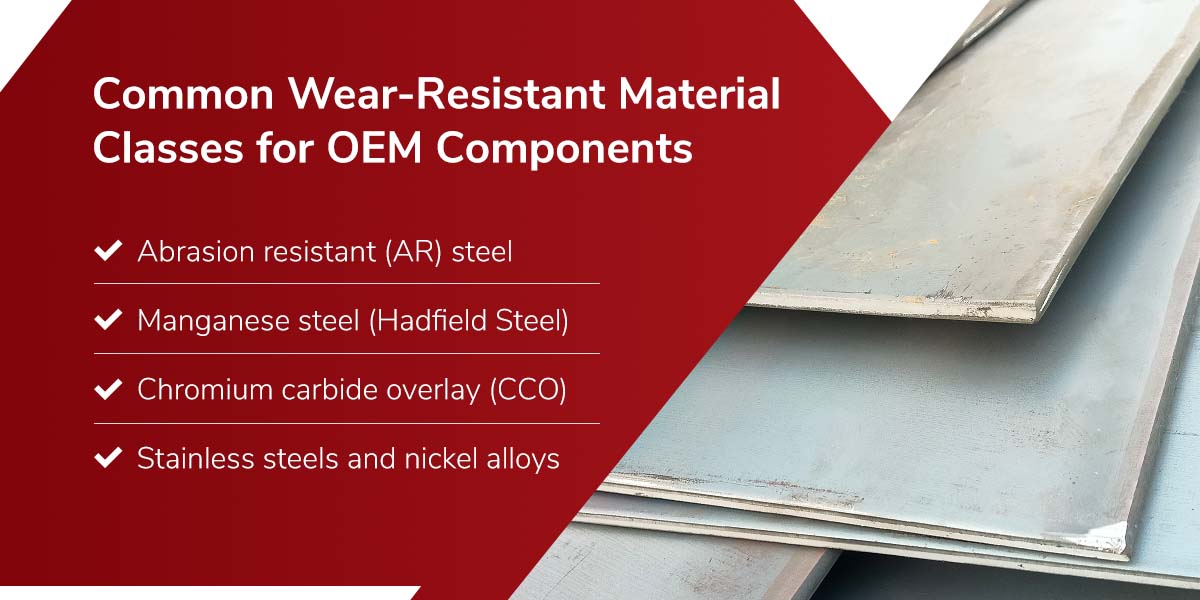
- Abrasion resistant (AR) steel: Quenched and tempered (Q&T) steels like AR400 and AR500 are the industry standard for sliding abrasion applications, such as liners, loader buckets and dump bodies. The AR grades correspond to Brinell hardness, with AR400 around 400 HBW. These steels are engineered to resist surface damage from grinding and scraping, making them foundational abrasion-resistant materials across industries.
- Manganese steel (Hadfield Steel): Manganese steel’s signature feature is its work-hardening ability. It becomes more abrasion-resistant as it endures repeated impacts. This material is common in high-impact environments like rock crushers and railway crossings. However, the trade-off is that it’s challenging to machine or cut this material without special tools, underscoring the importance of sourcing and fabrication knowledge.
- Chromium carbide overlay (CCO): When extreme abrasion trumps all else, composite materials like CCO plates come into play. By welding a layer of hard carbide onto a tough steel base, you achieve an ultra-wear facing that’s nearly impossible to gouge or score. However, these overlays are not tough enough for heavy impact.
- Stainless steels and nickel alloys: In operations combining heat, corrosion and abrasion, such as in chemical plants or food processing, chemically resistant alloys are the answer. A 300-series stainless steel delivers solid corrosion protection with decent toughness. Duplex grades provide higher strength with improved wear and chemical resistance. High-nickel alloys step in when the aggressive chemistry or high temperature rules out conventional steels.
The Fabricator’s Challenge: Processing High-Wear Materials
Setting the spec is only half the equation. The real challenge begins in execution, turning high-performance alloys into finished components that maintain their engineered properties. Many fabrication shops falter when working with tough or exotic materials because they lack the necessary tools, machines or know-how to preserve properties during fabrication.
Why Hard Materials Are Difficult to Cut and Machine
Wear-resistant alloys are harder on your tooling. AR plates and high-nickel alloys require high-rigidity CNC machines, strategic feed rates and advanced consumables to avoid premature wear or outright failure. The best approaches are grounded in standard operating procedures that match tool selection to each alloy, enabling precision machining while maintaining required tolerances and finishes.
Welding Considerations for High-Strength Alloys
Welding high-strength or abrasion-resistant materials is an art and a science. A single misstep, such as using the wrong filler metal or cooling the material too quickly, can result in hydrogen cracking or leave the part dangerously brittle. Teams must closely manage the heat-affected zone to avoid softening or shattering the finished component. Welding procedures designed for sensitive alloys reduce the risk of failure in critical parts.
Expert Execution for Customer-Specified Wear Components
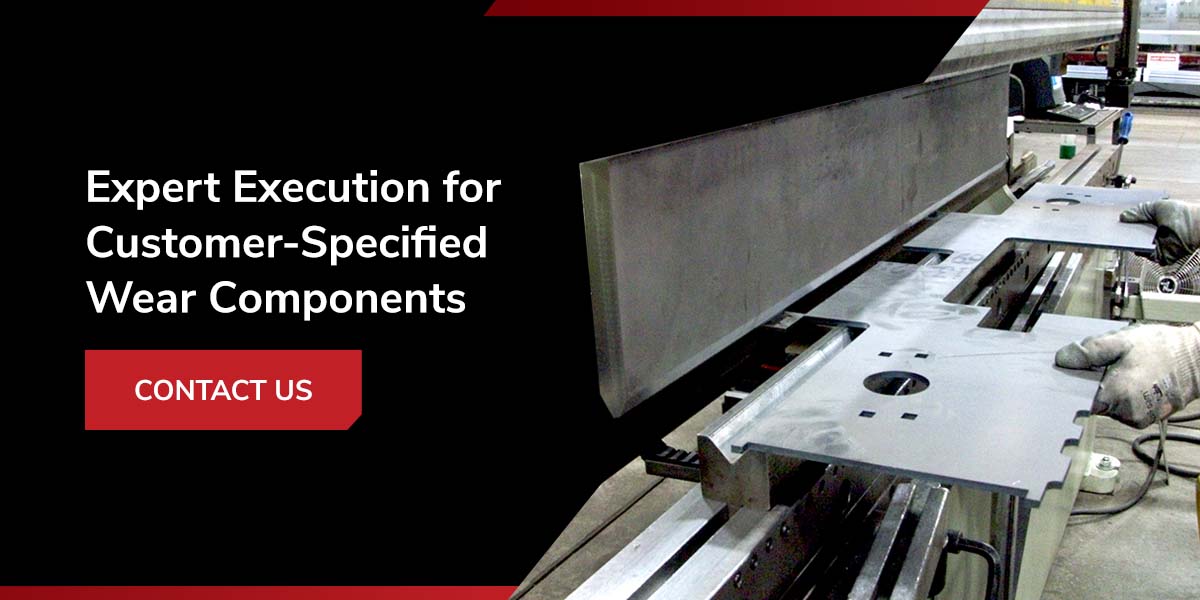
Selecting the optimal wear-resistant materials is only the beginning. With Pro-Cise, end customers determine materials, and we turn tough requirements into engineered parts built to your production schedule. We have strong relationships with material suppliers and bring extensive experience working with a wide variety of materials, including those that may require special traceability or compliance documentation. Where our competitors hesitate, we take on complex projects. Our facility can handle large, heavy and complex components that require exacting standards, from the initial drawing to the final finished part.
Each part we produce is backed by rigorous quality standards, in line with ISO 9001. We understand that when a component fails, the whole machine stops. That’s why we don’t compromise on quality or testing and inspection standards that support our customers’ most demanding applications.
Don’t let fabrication limitations dictate your operations. If your application requires abrasion or erosion-resistant materials, contact Pro-Cise for a quote. We’re ready to deliver dependable, production-ready wear components that work just as hard as you do.