
Supply chain disruptions have shifted from occasional setbacks to persistent operational realities. Trade uncertainty, logistical bottlenecks and geopolitical volatility have transformed fragmented, reactive supply chains into significant business liabilities. According to a National Association of Manufacturers’ outlook survey, 78% of manufacturers report that trade uncertainty remains their top concern.
Building a resilient supply chain requires a different strategic approach, one focused on proactively identifying vulnerabilities, optimizing sourcing decisions and cultivating partnerships that deliver stability and competitive advantage. This guide provides actionable strategies to help you strengthen your OEM supply chain from the ground up.
Building a Resilient and Risk-Proof Framework
Proactive risk management is the foundation of any modern OEM supply chain strategy. Without it, even the most efficient operations remain vulnerable to disruptions that can halt production, inflate costs and damage customer relationships.
According to the World Economic Forum’s Global Value Chains Outlook 2026, 60% more leaders see resilience and agility as core to competitive advantage and growth than they did five years ago. This shift reflects a growing recognition that supply chain strength isn’t just about cost — it’s about continuity.
Identifying and Mapping Your Core Supply Chain Vulnerabilities
The first step in supply chain risk mitigation is conducting a thorough audit of your existing network. A supply chain stress test reveals weak points before they become critical failures. Start by evaluating these critical exposure points:
- Geographic concentration: Evaluate how many of your Tier 1 and Tier 2 suppliers are located in the same geographic region. Determine the potential impact of a single weather event, political disruption or recurring tariff change in that area.
- Single-source dependency: Identify which components have only one qualified supplier. Next, calculate the realistic lead time required to qualify an alternate supplier if that source became unavailable.
- Logistical bottlenecks: Map the longest lead times in your chain and pinpoint the specific ports, canals or shipping routes most vulnerable to disruption.
Once you’ve laid out these vulnerabilities, the next step is creating an early-warning system to monitor them in real time. A proactive system allows you to respond to emerging risks before they escalate into full-scale disruptions.
Strategies for Mitigating Common OEM Supply Chain Risks
Now that you’ve identified your risks, you need actionable tactics to address them. Think of supply chain risk mitigation as a toolbox, where each strategy solves a specific problem.
- Strategic buffering: Calculate and maintain extra inventory only for the most critical, long-lead-time components identified during your mapping phase. This targeted approach prevents both stockouts and excess working capital tied up in slow-moving inventory.
- Proactive multi-sourcing: Qualify and maintain relationships with second- and third-source suppliers for critical parts before a crisis hits. Waiting until you need an alternate supplier puts you at a severe disadvantage.
- Embracing technology for visibility: Modern tools like digital twins, AI forecasting and real-time tracking platforms provide the visibility needed to manage inventory intelligently and respond to disruptions faster. Technology turns reactive firefighting into proactive planning.
The Role of Quality Management in Long-Term Resilience
Quality control directly impacts supply chain resilience. A robust quality system prevents defects, rework and delays that create downstream disruptions and cost overruns. When components fail to meet quality standards, production stops, regardless of how well you’ve optimized other aspects of your supply chain.
Partnering with manufacturers that maintain documented quality management systems and certifications like ISO 9001 ensures consistent output and reduces the likelihood of quality-related delays. Qualified inspection processes, material traceability and adherence to industry standards create predictability in your supply network.
Optimizing Sourcing for Balance and Continuity
In today’s environment, where your parts come from matters as much as how they’re made. The key is finding the right balance between cost efficiency and operational resilience.
Balancing Global and Domestic Sourcing
Global sourcing often delivers lower per-unit costs but introduces longer lead times, higher shipping expenses and exposure to geopolitical risk. In contrast, domestic sourcing typically costs more per part but offers faster turnaround, simpler logistics and reduced vulnerability to international disruptions.
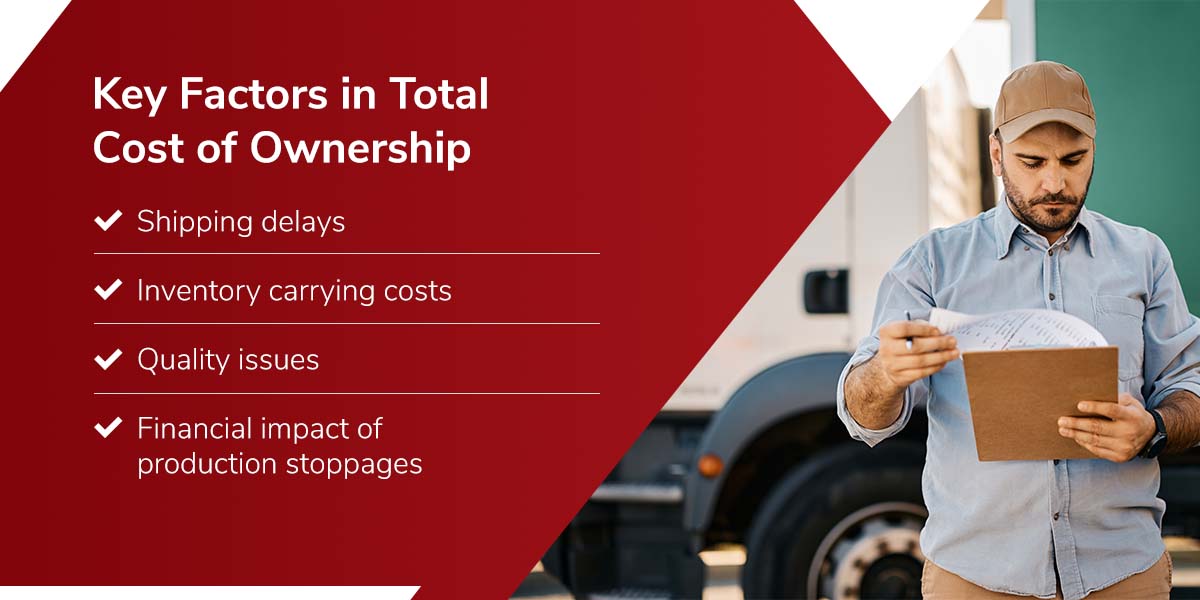
Rather than defaulting to the lowest cost option, evaluate suppliers based on total cost of ownership. Factor in variables such as:
- Shipping delays
- Inventory carrying costs
- Quality issues
- Financial impact of production stoppages
Reshoring or nearshoring critical components can actually reduce total costs when you account for these variables. Evaluate the benefits of balancing global and local sourcing based on component criticality and lead time sensitivity. High-volume commodity parts may justify global sourcing, while critical wear parts with unpredictable demand patterns often benefit from domestic suppliers who can respond quickly to changing requirements.
Best Practices for Diversifying Your Supplier Base
Single-sourcing creates a single point of failure in your supply chain. If that supplier experiences capacity constraints, quality problems or operational disruptions, your production stops. A diversified supplier base provides continuity when individual suppliers face challenges.
Start by identifying components where single-source dependency poses the greatest risk. Then, begin qualifying alternative suppliers. For each critical component, qualify at least two suppliers capable of meeting your specifications and volume requirements. Maintain regular communication and place periodic orders with alternate suppliers to preserve the relationship and ensure their capabilities remain up to date.
Using Strategic Partnerships for a Competitive Edge
One of the most significant opportunities when creating an OEM supply chain strategy involves shifting from transactional vendor relationships to strategic manufacturing partnerships. According to the World Economic Forum, 3 in 4 leaders would prioritize resilience investments, such as strategic partnerships, for superior returns. These strategic OEM partnerships deliver competitive advantages that extend far beyond cost reduction.
Moving From Transactional Vendors to Integrated Manufacturing Partners
The transactional model focuses exclusively on cost per part. Purchase orders go to the lowest bidder with minimal ongoing communication or collaboration. This approach creates fragmentation, increases administrative overhead and limits opportunities for process improvement.
An integrated manufacturing partnership focuses on total cost of ownership and operational efficiency. The benefits of this partnership model include:
- Reduced complexity: Consolidating suppliers eliminates coordination overhead and simplifies procurement processes.
- Better communication: Closer collaboration prevents errors that lead to costly rework or delays.
- Shorter lead times: Integrated production planning improves scheduling efficiency and responsiveness to changing requirements.
- Reduced overhead: Managing fewer vendor relationships frees up procurement resources for strategic activities.
- Improved quality control: Closer collaboration enables proactive quality management rather than reactive inspection.
The best results come from long-term, collaborative partnerships in which your manufacturing partner understands your business and serves as a strategic advisor, not just a parts supplier. Outsourcing to contract manufacturers who think like partners transforms your supply chain into a competitive advantage.
Capabilities to Look for in a Strategic Partner
A true strategic partner brings more than manufacturing capacity. Evaluate potential partners based on the following criteria:
- Technical expertise in your industry: Partners who understand your specific requirements can provide valuable input that’s directly relevant to your business.
- Certified quality management systems: Quality control processes backed by ISO 9001 certification or the equivalent demonstrate a commitment to documented, repeatable processes and continuous improvement.
- Comprehensive in-house capabilities: A partner with end-to-end manufacturing capabilities can handle fabrication, machining and assembly under one roof. This integration eliminates handoffs between multiple suppliers and provides single-point accountability.
- Strong material sourcing relationships: Evaluate their ability to work with unique or specialized materials. Strong vendor networks ensure better supply chain continuity and material traceability when required.
- Inventory management flexibility: Assess their willingness to maintain inventory for high-volume part numbers to reduce your lead times and free up your floor space.
Enhance Your OEM Supply Chain Strategy With Pro-Cise
Building a resilient OEM supply chain requires more than tactical adjustments. You need a manufacturing partner who understands the strategic challenges you face.
Pro-Cise provides end-to-end metal fabrication and machining solutions designed to reduce supply chain complexity and improve continuity. From sourcing unique materials to managing complete production processes through delivery, we handle the projects other contract manufacturers won’t take on.
Our ISO 9001-certified quality management system, comprehensive in-house capabilities, and expertise in complex fabrication ensure your critical components arrive on time and according to your specifications. Contact us today to discuss how we can strengthen your supply chain strategy.